

The Most Expensive Employee in Your Business Is You
Business Partner · 25 October 2026 · 5 min read
Every owner knows what their people cost. You know the salaries, the overtime and what a new hire would add to the monthly bill. You have probably argued with yourself about whether a role is worth it.
There is one employee whose cost almost never gets that scrutiny. They work the longest hours, take the most calls and approve the most things. The most expensive employee in your business is you, and nobody is checking how your time is spent.
Put a price on your hour
Most owners have never priced their own hour, because nobody sends them a payslip that makes the question unavoidable. But the business pays for your time all the same. It pays in what you earn, and it pays far more in what you could be doing instead.
Say you value your hour at R1,500. That is not an extravagant number for the person who wins the large customers, sets the prices and decides who to hire. On a good day, one well-handled conversation can be worth many times that.
Now look honestly at last Tuesday. How much of it went on work that only you could do, and how much went on work you could have handed to someone earning R200 an hour?
If you would not pay R1,500 an hour for a task, you should not be doing it.
The R200 work that fills the day
The R200 work is rarely dramatic. It is chasing an invoice, finding a document the accountant asked for, checking whether a supplier was paid and reminding a customer of what was agreed. Each task is small, sensible and quick on its own.
The trouble is the total. Say three hours a day go on work of that kind. At R1,500 an hour you are spending R4,500 of your time to get R600 worth of work done. Over a month of twenty working days, that is R90,000 of owner time absorbed by tasks the business could have bought for R12,000.
Those figures are an illustration, not a study, and your own numbers will differ. Run them anyway. Most owners who do find the result uncomfortable.
The cost is not the R200 task. It is the R1,500 hour it quietly replaced.
Why owners keep doing it
None of this happens because owners are careless. It happens because the small work is right there, it feels urgent and finishing it brings a pleasant sense of progress. Nobody gets a twinge of satisfaction from leaving a hard pricing decision for another week.
There is also the matter of trust. Owners often keep routine work because they are the only ones who remember the history. They know which customer always pays late, which supplier changed terms and what was promised on the phone in March.
So the work stays with the owner, not because it needs the owner's judgement, but because it needs the owner's memory. That is an expensive way to store information, and a fragile one, because it disappears the day you take leave.
Doing it yourself feels like control. Often it is just the most expensive option available.
What your best hours should buy
If your hour is worth R1,500, it should be spent where that value is created. That means the customer conversation that reshapes a relationship, the price rise you have been putting off and the decision about whether a struggling service should continue.
These are not tasks you can tick off before lunch. They need a clear head, some quiet and enough context to think properly. They are exactly the decisions that get squeezed when the morning has already gone on admin.
The irony is sharp. The work that only you can do is the work you most often leave until you are tired. Your best hours belong to your hardest decisions, not your easiest ones.
Stop being the filing system
Handing work over is the obvious answer, and part of it is right. Some tasks should move to a bookkeeper, an assistant or a capable member of the team. But many owner-led businesses are too small to hire their way out, and some of the burden is not a task at all.
Much of the owner's day goes on remembering and checking. Did they pay, did I reply, what did we agree and is anything about to go wrong? That background job never appears in a job description, yet it consumes attention all day.
The fix is not working harder at remembering. It is making the business remember for you, so that the right matter returns at the right moment with its history attached, instead of living only in your head.
An owner who is also the filing system is paying senior rates for clerical work.
Buy back the expensive hour
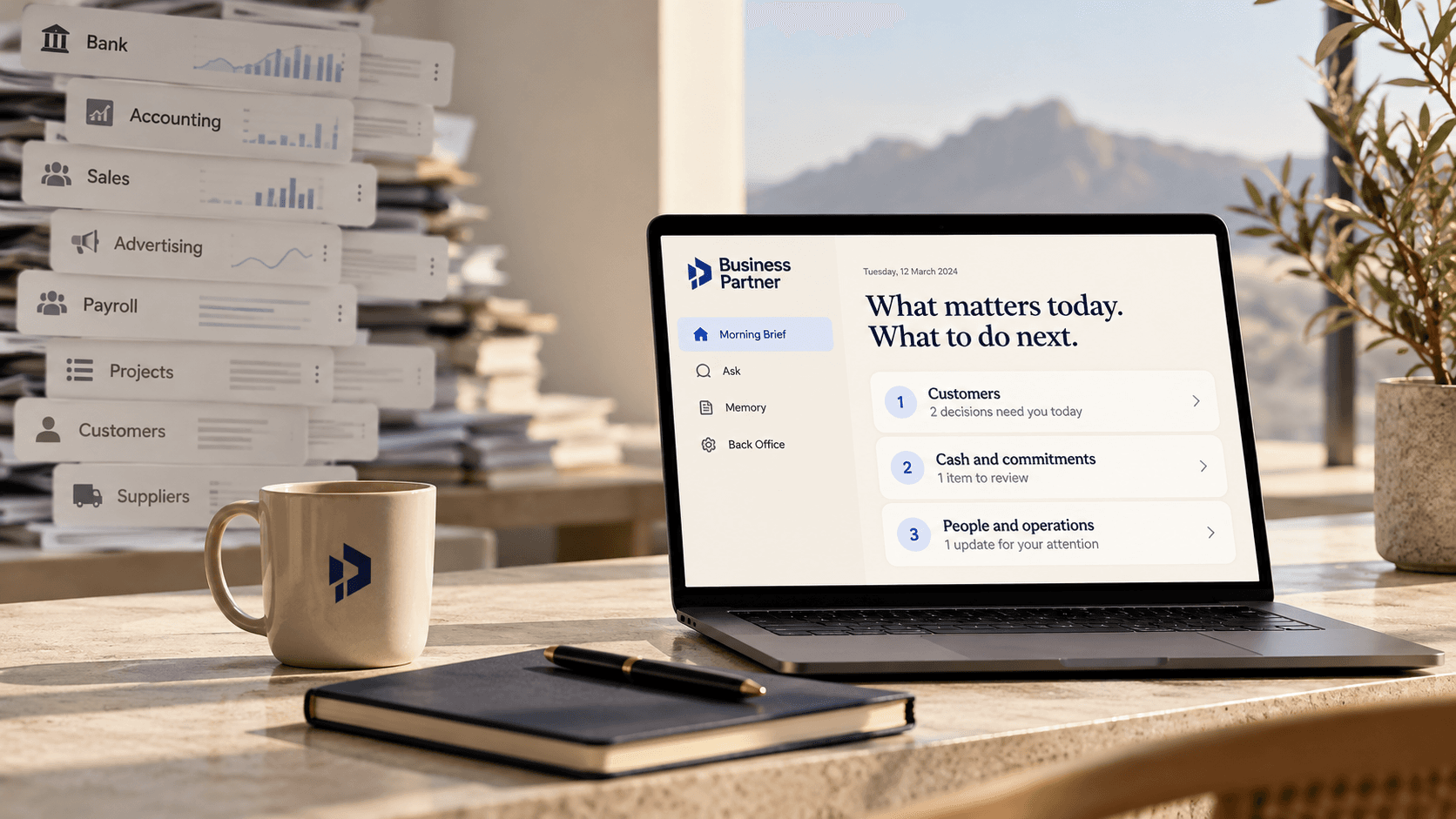
This is the job Business Partner is built for. Each morning, the Morning Brief brings forward what genuinely needs you and prepares the next step, so that a reminder or follow-up is ready for your approval rather than waiting for you to draft it. You decide what goes ahead.
When a question comes up, Ask answers it from your own business evidence, so you are not digging through records to rebuild the picture. Memory keeps the understanding of your business, the agreements, the history and the context, so it no longer depends on you recalling it at the right moment.
The point is not to remove you from the business. It is to stop spending a R1,500 hour on R200 work, and to give that hour back to the decisions only you can make.
Your time is the most valuable resource your business has. Start paying for it like it is.
See your own Morning Brief
Send the aged debtors report your accounting system already produces and see who to chase first.
Try it with your reportKeep reading

Stop Paying for Software That Makes You Do the Work
Most business software hands the owner more to check. The tools worth paying for prepare the next step.

Every Business Owner Needs a Thinking Partner
More information does not solve the shortage of attention. Better judgement about what matters might.
Why Business Owners Don't Need More Dashboards
The problem is rarely that the owner cannot see enough. It is that too much is competing to be seen.